

No More Introverts
Times are lonely. People aren’t.
Let’s put a pause on the concept.
Let’s stop talking about “introverts” as a type of person. Pop psychology takes introversion to be a personality style characterized by a “preference for the inner life of the mind over the outer world of other people.”1 Our culture elevates introversion to ontology—Peter is an introvert, his nature is to be quiet, he belongs in his own head. A fly-by of the Google search results confirms it: there is nothing wrong with being an introvert; we need to stop treating it as an ailment; if you are an introvert, you don’t need to change anything. Introvert or extraverts alike are invested in categories themselves.
The dichotomy puts me in an awkward spot. Put me through an Myers-Briggs and you’d probably get something like “ambivert.” Most people seem to be like me. Many eras of my life—middle school gothic sulking, idle high school summers, the stumbling start to college—were spent deep in this “inner life of the mind.” I take shorter retreats to reticence as well: a sophomore year summer working in a new city; a lonely winter break at home; a solo voyage abroad. And yet if you met me now, you’d probably confidently stick me with an “E” for my MBTI. If my efforts paid off, then it’s true.
I chose the “outer world of other people” to be happier. It takes just a cursory inventory of my life experiences to see why. My happiest memories were distinctly social: delivering a closing speech in the finals of a debate tournament; a psychedelic journey on a Marin County beach with my housemates; banter at Rayleigh’s at a table with cheap margaritas and rich personalities. No need to share details here, but the inverse is equally true: my lowest lows were spent wallowing and bellowing alone. Life’s foreground—everyday passions, projects, pursuits—seems more cheery with good company in the background. I suspect and hope you relate to this too.
I feel it viscerally, but now we know it empirically too. Social scientists studied a thousand human lifetimes to arrive at a single truth: close relationships with our fellow creatures are the key to a happy life.2 Our relationships predict our deaths better than obesity or exercise. Our social communities keep us sharp and youthful. Our communities cure and prevent depression. In Maslow’s hierarchy, human relationships sit right below food, water, and shelter. The most common dying regret is losing touch with friends. Money mostly makes us happy through caring and spending time with others. I don’t think I exaggerate at all in saying that people are pretty much everything.
We are losing everything. In 2024, we are ”dating less, playing fewer youth sports, spending less time with [...] friends, and making fewer friends to begin with.” It’s no surprise. The COVID-19 pandemic lacerated the social fabric of our communities and the wounds are still healing. Our ever-advancing technology (phones, tablets, Netflix, short form videos, social media, video games, work from home, home devices, online delivery) ensconce the user in lonely contentment. And for a recent grad like me, it seems normal, expected, to put my career over my friends. Many have elegantly dissected these trends and each deserves its own book.3 But the factors share at least one common accomplice: the concept of introversion itself.
A fundamental attribution error is happening on a grand scale. We confuse lonely circumstance for lonely character. As the world gets lonelier, our baseline for normal social interaction drifts down in lockstep. When a friend is locked up at home, constantly online, or holed up at work, we start to suspect that “that might just be how they are.” We shouldn’t encroach on their way of life, cross personal boundaries, exhaust them with social invitation. When someone drifts away, we hesitate to pull them back. That someone, needless to say, could be none other than yourself.
To identify as an “introvert” is to retreat. It abandons the hard work of social existence. If you actually take the 16Personalities test, it will prompt you consider things like whether you “regularly make new friends” or are comfortable approaching strangers. But these are outcomes, not processes. It takes intention, practice, and a little luck to strike up a conversation and get to know someone. “Extroverts” are not a mystical subspecies; they are homo sapiens who do the day-to-day work of planning events, keeping up with friends, and showing that they care. To embrace the introverted outcome—to say that “it is ok to be an introvert”—skirts these shared duties. I worry that in practice, accepting introversion means smaller parties, shorter calls and fewer hugs. And if these trends are self-reinforcing, introverts are retreating off a steep cliff.
Perhaps we can save “introversion” if we reshelf the concept from personality psychology to psychology of habit. We might treat antisocial tendencies the same way we treat smoking or a sedentary lifestyle. The question is not whether these behaviors are desirable (nope!) or intrinsic (obviously not!), but how to help people while respecting their autonomy. Like tossing the vape or hitting the gym, putting yourself out there is difficult but certainly possible. Consider Jessica Pan, Olga Khazan, or Sirin Kale, who made conscious commitments to do extroverted activities despite their first impulses—to great reward! For most, it takes a supportive environment, a bit of time, and a gentle nudge to dislodge the habit. Encouragingly, just getting people to pretend to be extroverted—even when they expect to hate it— has “surprisingly powerful” benefits for wellbeing.4 Unlike introversion-the-personality, we can change introversion-the-habit in both ourselves and others. This provides a basis for hope and calls for a new kind of social responsibility.
Here’s a flavor of the responsibility I have in mind. Both introversion and extroversion stem from the Latin root vertere, meaning “to turn.” Etymologically speaking, people are either turned inwards or turned outwards. There’s a Greek synonym, tropos, also meaning “to turn.” The Greek tropos gave us tropism, referring to “turning in response to external stimuli.” Tropism, e.g. a sunflower twisting to track the sun; a tree flexing its roots in search of water. I like the word because it emphasizes the cause of the turning. A sunflower droops in the dead of night; a tree shrivels up in the desert.
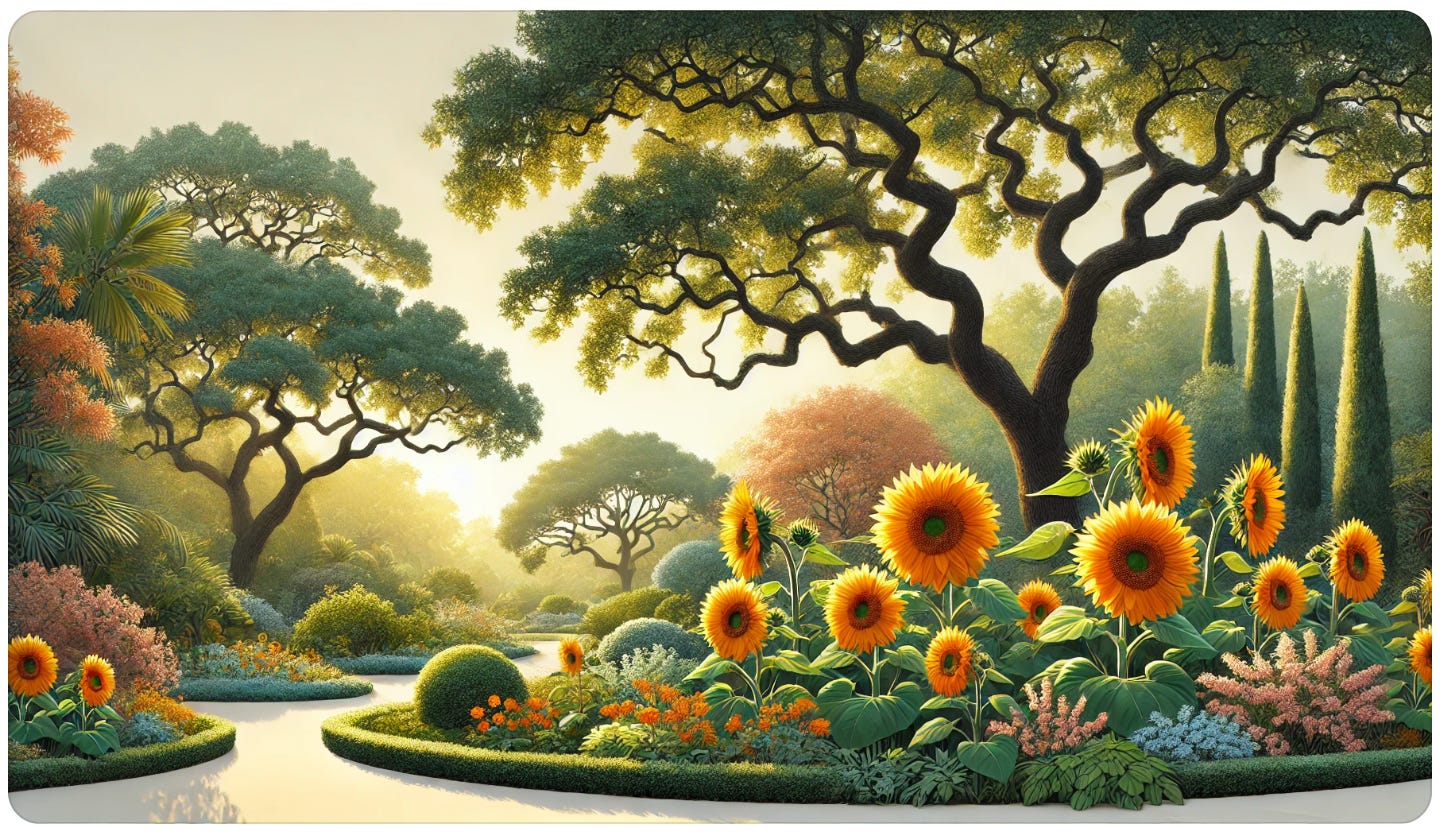
A friend recently taught me to think of the people in your life as a garden. You have flowers that line the promenade, flashing brilliant colors when the season is right. You have ancient oaks that tower dutifully for decades. A tough winter settles in and you emerge to a backyard of withered sunflowers and parched trunks, a community of floral introverts. Won’t you make room for light and sprinkle some water? Can you cultivate just a little patch? Can we all try our best to bring about a beautiful spring bloom?
Call your friends. Make plans. Don’t flake. Be present. Hug them goodbye.
And if you were hesitating before, reach out. I’d love to hear from you, truly.
I ripped the definition from Psychology Today, but the rest are similar (see results 2, 3, or 4).
I’m talking about the Harvard Study of Adult Development. Here’s the press release for the Harvard study and some news converge I enjoyed from The Atlantic. Plus a Ted Talk, if you prefer.
The other studies I randomly ripped from Google. I did very little auditing and this piece probably wouldn’t pass peer review. I think this post is more meant to be “provocative” anyway.
Re: the pandemic. This piece puts it poignantly:
Before the pandemic, it seemed an accepted truth that there’s inherent benefit to human connection and gatherings. [...] . The conundrum of my recent months has been how much to exhort people to step outside (safely) and how much I should accept that I now live in a world in which there are fewer parties, fewer shows, fewer summer festivals and dinners and trivia nights and cocktail hours. [...] Some might call voluntary isolation “self-care.” But multiplied throughout our society, could it end up looking more like an unhealthy descent into solitary confinement?
Re: technology. I enjoyed Jonathan Haidt’s book, which makes a well-researched case for social media’s deleterious effect on mental health generally and loneliness in particular. He has a good summary interview with Derek Thompsom on his podcast. The podcast is home to yet another gem: a segment he discusses technology’s role in playing a dopaminergic trick, making us thinking we’re happy alone on a screen when such satisfaction can only ever be temporary.
Re: work. Derek Thomson’s slim volume On Work elegantly examines our unique American relationship to employment.
It might be the case that self-described introverts tire faster in social situations. Now maybe you’ve been thinking this all along. You’ve been itching to tell me that introversion is about how much energy socializing takes. You want to explain that I’m attacking a strawman. And you might be right, prescriptively. I just don’t think that quite tracks how we throw around the term day to day. Pop culture seems to think that a socially drained introvert just doesn’t prefer company to begin with. I’m also not sure it changes the story so much. If social interactions were tiring before, then they must be soul-sucking today. When people are harder to contact, slower to respond, and more likely to flake, everyone’s activation energy goes up. That’s the kind of social norm I think we should strive to fix. Seeing people is exhausting because we made it that way.
wake up babe, new peter zhang substack article just dropped
Despite wanting to laugh off MBTI as a social model, I think I really internalized the natural introvertedness idea. Good to have a bit of a wake up call!